Facebook Ads (Beta)
Book Report can import your Facebook and Instagram advertising activity and show it alongside your publishing income. Facebook Ads support is currently in beta.
Connecting Facebook Ads
- Open Book Report and go to Settings → Data Sources.
- Find Facebook Ads (Beta) and click Connect.
- Follow Facebook's prompts to connect your account.
- Back in Book Report, choose the ad accounts you want to import.
- Once you save your choices, Book Report will begin importing data from those accounts.
Book Report imports the previous 365 days of advertising activity, starting with the most recent 30 days and filling in older history in the background. If you already connected Facebook Ads during the beta, the additional history will load automatically. The most recent 30 days refresh approximately every six hours, including while older history is loading.
Facebook grants this access for about 60 days. When it expires, return to Settings and reconnect Facebook Ads to resume imports.
Using Facebook Ads in reports
Book Report adds Ad Spend to your default Today and Historical tables when you connect Facebook Ads. You can also add these advertising metrics to reports:
- Ad Spend
- Amazon Ad Spend and Facebook Ad Spend, offered together when both platforms have non-zero spend in the current report window
- Net Earnings
- Impressions
- Clicks
- CPC
- CPM
- CTR
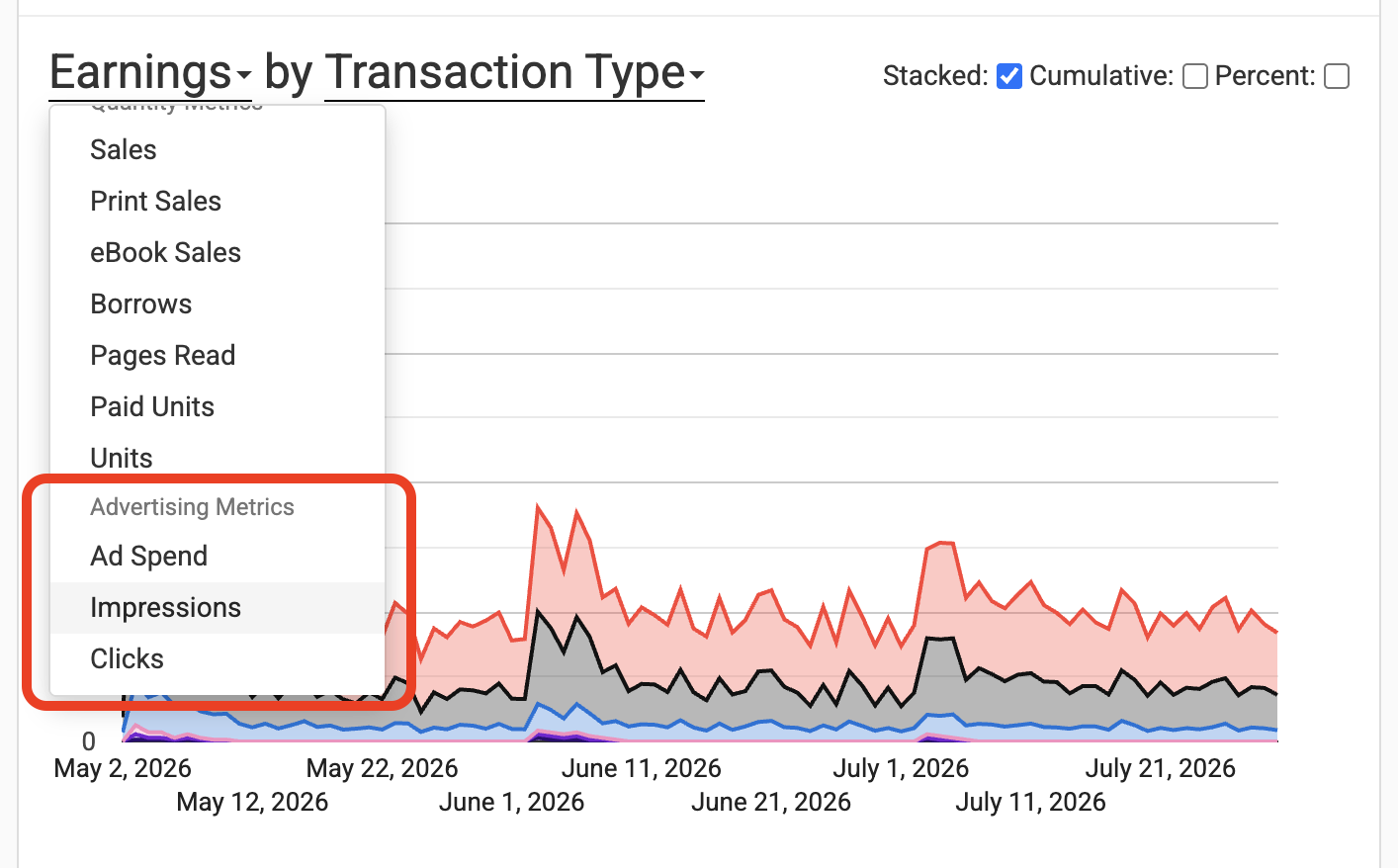
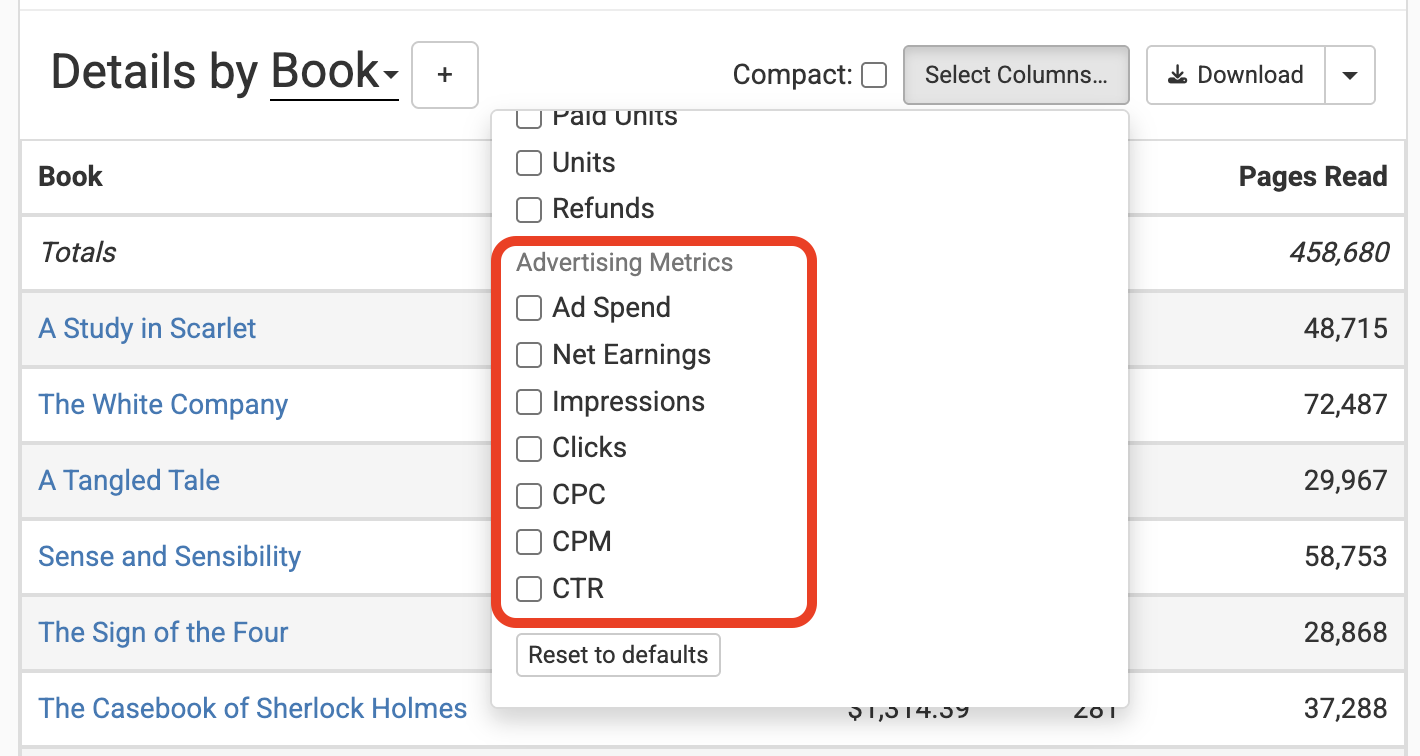
You can add the same advertising metrics as columns in details tables:
Facebook's campaigns, ad sets, and ad accounts are available in Book Report as Campaign, Ad Group, and Ad Profile. Ad Platform distinguishes Meta activity from advertising imported from Amazon. You can use these attributes in tables, charts, and filters like other Book Report attributes.
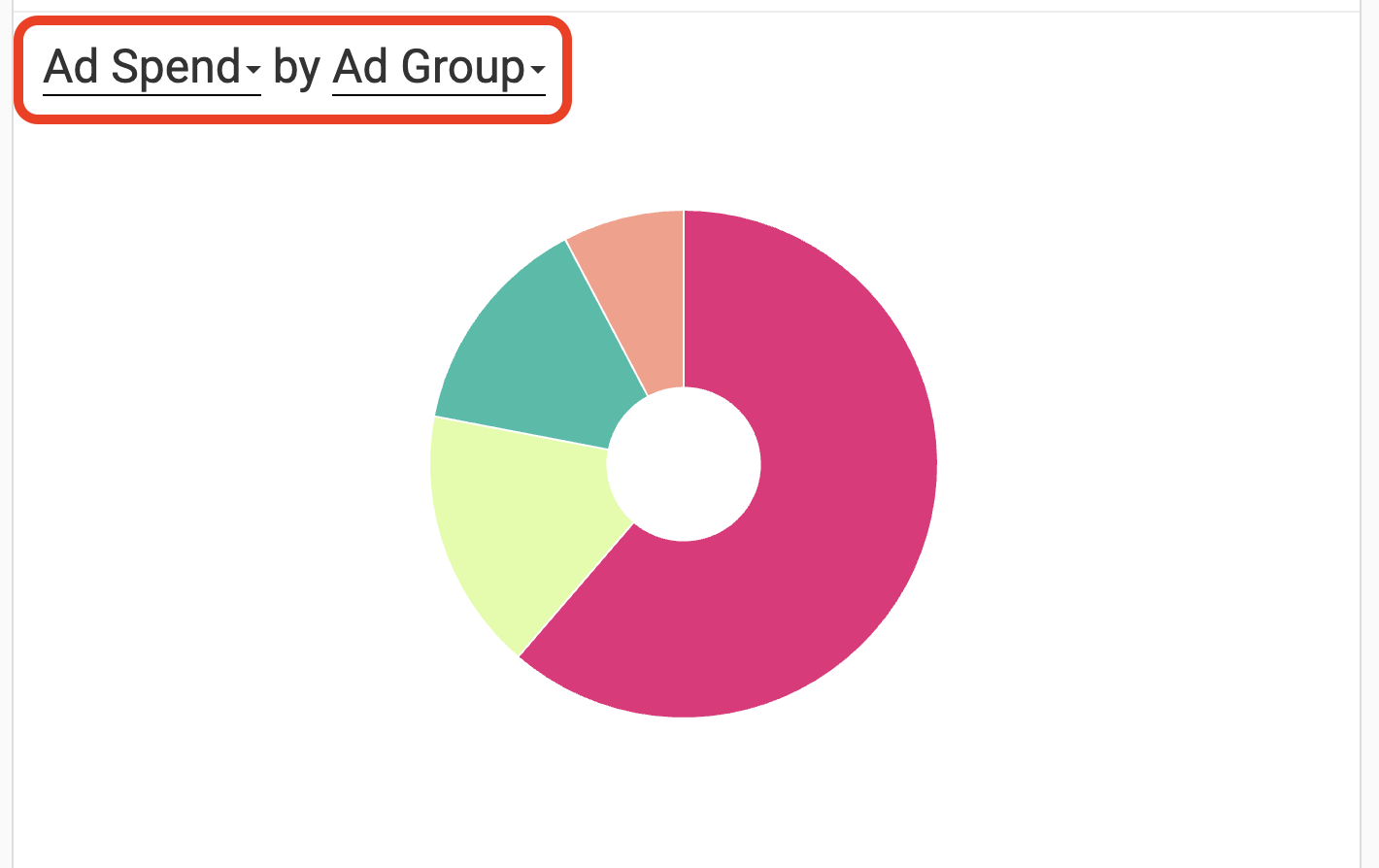
For example, you can view Ad Spend grouped by Ad Group:
Matching ads to your catalog
After you've connected your Facebook account, you'll see a new Ads tab, where you can manage how Book Report understands your advertising. Instead of managing ads individually, Book Report’s understanding is based around destinations. Where is an ad sending people? We call that the ad’s destination.
Facebook provides rich data about ad spend, clicks, impressions, but it does not connect those metrics to the books, authors, and series that make up your actual business. That’s what the ads tab is for - establishing links between Facebook data and your Book Report catalog. Once the link is established, Book Report can display very rich data. If we know that a destination points to a certain edition, then we can correctly categorize all of its spend not only to the right book, but the right author, series, format, distributor, and more.
How to use the Ads Tab:
- If your ad points to a book’s page on Amazon, Book Report will match it automatically. You can see the result of that match on the Ads Tab.
- If your ad points to a specific book, but we don't detect it automatically, you can match it by clicking Match to Book….
- Not all ads are for a single specific book. For instance, they may be lead generation for a series or author. You can enable the “Author” and “Series” columns and set them directly - this tells Book Report “All ad spend that points to this destination, categorize it under this author or series”.
- If you run some ads that are not relevant to the business you track with Book Report, you can click “Exclude from Reports” to ignore all metrics from ads pointing at that destination.
During the beta, if you feel unsure about how you’re supposed to use this system, please write me an email. I will be developing a video demonstration before moving this feature out of beta, so I'd love to hear from people about what makes sense, and what feels tricky.
Working with shared catalogs
If someone connects Facebook in their own Book Report account and gives you management access through data sharing, you can manage their destinations from your Ads tab. Use the Account picker at the top to switch between your account and accounts you can manage. You do not need to connect their Facebook account yourself. The picker appears when you can manage more than one account. When matching these ads to a book in another catalog, that book must also be shared with the account that imported the ads.
Automatic matching checks your books and books shared with you. With management access, you can also choose a shared book manually from the Ads tab. The saved link belongs to that book's catalog. Its owner does not need to have connected Facebook yet: if they later import ads pointing to the same destination, your saved link is already there.
A single ad account can advertise books from several catalogs. Exclusions, Marketplace, and direct attributes keep their existing ownership in the account that imported the ads. Read-only sharing allows automatic matching; management access is required to change a shared link.
Use Change Book… to choose a different book. To replace a manual match from another catalog, first use Remove Match. If you previously unlinked the destination, Restore automatic matching lets it use shared matches again. If several catalogs have manual matches for the same destination, Book Report asks you to remove the conflicting match before saving. Each change can be undone in the catalog where it was made.
If the same Facebook account is imported by you and someone sharing data with you, Book Report counts overlapping ad spend once and keeps history available only through the other import. Your own copy takes precedence where both exist.
Click View Recent Changes on the Ads tab to review, undo, or redo destination edits. Choose the catalog whose history you want to see. Changes retain the name of the person who made them.
Anything not working how it should?
Email me at liam@getbookreport.com with any feedback or bug reports. During the beta period, I am especially open to feedback and making changes.